Release what no longer serves you, align your thoughts with new possibilities, and walk into your transformed self
Healthy Doubt Saves Wallets: Lessons from a Real-Life WhatsApp Fraud

Healthy Doubt Saves Wallets: Lessons from a Real-Life WhatsApp Fraud
Karl Balloch
Recently, I became a victim of a WhatsApp scam that cost me bucks of euros. I want to share to help others stay alert and protect themselves. As technology advances, scammers become smarter and creative by each passing day. Scammers target our trust areas, often using emotional manipulation and urgency to rob even the most cautious people.
This experience taught me some lesson which I want to share with you:
Always start with doubt and end with trust.
Your trust should be conceived by your doubt.
Healthy doubt is not mistrust; it’s protection.
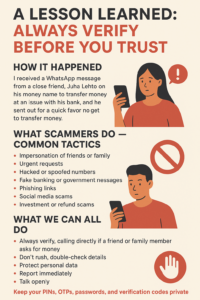
How It Happened
Recently, I received a WhatsApp message from one of my close Finnish friends. The message came from his real phone number and conversation began in a normal way as we often do.
He said he was having an issue with his bank and needed to transfer money urgently to someone else. Because I trusted him completely, I didn’t doubt for a second. I transferred the requested amount to a bank in Finland to the account he provided.
Everything looked normal and fine because of a real Finnish bank account number, a familiar name, and a trusted friend. That’s what made it so believable. For years, I have encouraged immigrants to fully trust Finnish social and official institutions, and to appreciate Finland’s safe and reliable environment which, sadly, made it harder for me to see the wolf in sheep’s clothing.
Anyway, a few minutes later, I learned that my friend’s phone had been hacked, and the scammer had read our previous WhatsApp messages and sent me messages impersonating him almost perfectly. The situation was now clear to me that my trust had been used against me.
What Scammers Often Do:
Intellectually I knew that scammers exploit trust, fear, and urgency. But in the real situation my mind switched to act quickly to prove care, love and favor which we all prefer to do in such situations. I would like to list some common methods scammers often use:
Impersonation of friends or family: Scammers hack someone’s account and message you as if they were your loved one.
Urgent requests: They claim it’s an emergency, for example medical bills, locked accounts, or travel issues or ATM networking issues to make you act fast without thinking.
Hacked phone numbers: They use the actual phone number or social media account of your loved ones, making it almost impossible to notice any difference.
Fake official messages: They send emails or text messages pretending to be from your bank, tax office, or even the police departments.
Phishing links: They share links when you click or sign in, they steal your personal details.
Social media scams: They build fake friendships to gain trust and sometimes spend money before asking for a big amount of money.
Fake Projects: They introduce profitable projects to steal personal and financial data.
What We Can All Do
if I had taken the following simple steps, I could have easily avoided this fraud:
Verify first: If someone among your family and friends asks for money through messages or emails, make a phone call to listen their voices and understand their situation.
Don’t rush: Scammers often create urgency because in haste you do not think much. So do not act quickly.
Cross-check details: A real A friend does not mind and understands if you take time to respond.
Protecting personal data: To protect your personal details, never share your PINs, one-time passwords (OTPs).
Report immediately: When you suspect that something is not right with you bank and social media account, contact your bank and police immediately.
Help others: Do not hide when you become a victim of fraud. Share your experience to educate others, e.g. family and friends, especially elderly people.
Appreciation and Awareness
I also want to extend my appreciation to the Finnish Police and the banking system for their accessibility. It was simple and fast to report the fraud and get guidance. Their understanding and attention gave me strength and hope during a very confusing and stressful moment.
I hope that by sharing stories like mine, learning from one another’s experiences, and staying alert, we can reduce the workload on police and financial institutions.
Final Thought
This experience taught me that trust is precious, but it must be earned through caution.
Start with doubt, and let your doubt give birth to your trust.
Let’s all learn, share, and stay aware, so no one else falls victim to scams that exploit our kindness and confidence.