Release what no longer serves you, align your thoughts with new possibilities, and walk into your transformed self
Lessons from the Winter War for modern immigrants

Lessons from the Winter War for modern immigrants
Winter War anniversary reflection
Karl Balloch
Today, eighty-six years ago, on the morning of 30 November 1939, at around 6:50 a.m., the Soviet Union launched a sudden and devastating attack on Finland. This invasion is known as “ Winter war or Talvi Sota”. In those days the population of Finland was 3.7 million with about 130000 military reserves standing up against its almost 50 times bigger opponent with 175 million population, 1.8 million (whole Red Army, but about 1 million personnel engaged at Finland’s border. Even though Finland was outnumbered, the Finns’ unity, discipline, and understanding of their forest and lakes helped them resist far longer than the Soviet leaders ever expected. Any war is terrible and it brings death,destruction, separation, starvation.Its aftereffects reshape social,
psychological, and economic dimensions of nations for generations. But in the midst of the USSR aggression, the Finns drew unity, discipline, mutual sacrifice, compassion and care for one another out of this enforced war.
Finland’s response became more than military resistance; it became a story of national dignity, resilience, and endurance.
Seven years ago,when I first arrived in Finland as a quota refugee, I honestly didn’t know much about the winter war, displaced people and refugees within the country. My curiosity to know about Finns and Finland led me to discover about the massive evacuation of people from Karelia that shapes such a significant part of the history of Finland. But as I started reading personal accounts from Kansallisarkisto and Yle Elävä Arkisto, something really touched me. That was when people had lost almost everything in the middle of war, but they still found ways to take care of one another.
Coming to Finland as a quota refugee, I find that these stories are still happening everyday in Finnish social life.
-
“We Shared What Little We Had”
(Based on accounts from Kansallisarkisto, Evakko Aineistot)
One story that really stayed with me was about a Karelian displaced mother travelling with her children during the 1940. They were just having a piece of rye bread. They did not hope of getting any edible in the next few days.The mother noticed a weak and fragile elderly couple. They were about to collapse for not having sufficient food to eat enough for the last few days. She said something like:
I decided to share my children’ only bread with this starving elderly couple sitting next to us. Otherwise they wouldn’t survive that cold night.
Later on, one of those elderly women, recalling that exhausting journey, said during an interview:
“People helped each other, even when they rarely had anything themselves. That’s the only way we got through it.”
Going through all these testimonies, It was impossible for me to not be touched. My understanding was that sharing food and belongings with others during challenging times isn’t just human care. But it is a way of stirring up hope, and strengthening the bonds within a community. Seeing that the Finns did it well, even during such a dark chapter of their history, was remarkable and moving.
-
“Good Samaritans of Viipuri ”
(Based on stories from Yle Elävä Arkisto: Evakot)
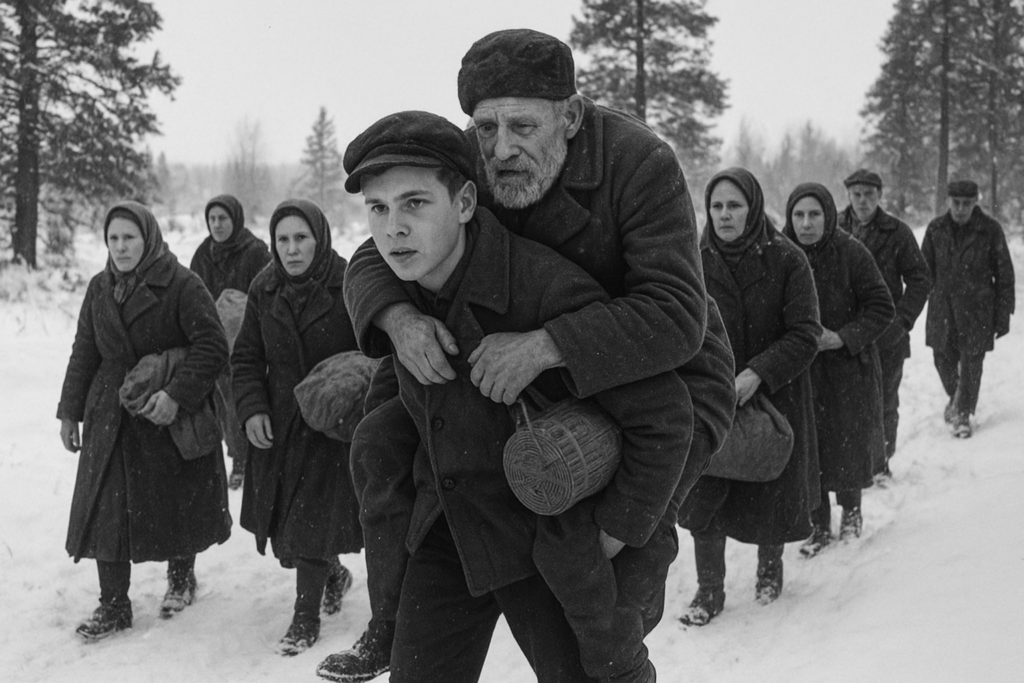
Another story I read was about a family leaving Viipuri with a teenage boy. While walking their way down a snowy road, they found an old man, who was so exhausted that he was simply unable to walk any farther. The boy said to his family and others:
“I couldn’t just leave him there and pass on. So he carried him on his back for miles. Seeing this compassion,others also came forward offering blankets to keep the old man warm. Later, the old man said:
“ That teenage boy did more than save a life. He restored my faith in humanity.”
The Finnish sisu isn’t just about enduring challenges and hardships. It’s also about carrying the weak and wounded on your back.
These Stories Still Teach Us Today
These memories from Winter war history carry real meaning for us now and today. Finland continues to practice compassion and support people fleeing from wars, social injustice and difficult circumstances. For those of us who have arrived in Finland as immigrants and refugees, these stories are having powerful lessons of gratitudes and appreciation. Remember how much the elderly couple was thankful for the piece of rye bread, and the old man who was appreciating the kindness of a teenage boy for the rest of his life.
And the lesson is still the same:
When someone or a community shows kindness to you, be thankful. Respect, and respond with appreciation, and when you are able, pass that kindness on to others.
Finland invests a huge amount of resources in housing, education, healthcare, language learning and vocational courses, and all kinds of support for people who came here as immigrants and refugees to start a new life.These are modern versions of the same acts of kindness shown on those snowy evacuation routes of Karelia.
Today, November 30th, marks the 86th anniversary of the USSR’s invasion of Finland. And as I see history echoing now, let’s think about what the testimonies of care and compassion are teaching us today.
I think of the elderly couple, expressing gratitudes for receiving a piece of bread. It makes me ask myself:
Am I that grateful for the safety that Finland offered me?
I remember the old man who said, “That boy just did not save my life. … he restored my faith in humanity.” It makes me think:
Do I really appreciate, and thankful for the support I was given?
And the Karelians, who worked hard and rebuilt their lives from nothing. So I ask myself: Finland has given me a second chance. Am I seriously making efforts to rebuild my life?
The Finns helped each other through unthinkable hardships in the midst of war and they still do. They cared for their own people in the past when the war displaced them. And today Finland is one of the lampstands of hope for people fleeing from wars, social injustice, and discrimination.
So let’s be honest, sincere, and genuinely thankful just as the Karelians were.
Kiitos Suomi. Thank you. We are grateful for the remarkable kindness you’ve shown us.
Sources: https://yle.fi/a/20-10007469
https://sotamuistot.arkisto.fi/fi/